
How Much Internet Bandwidth Does VoIP Actually Need?
One of the most common questions businesses ask when considering VoIP is whether their internet connection is fast enough. The surprising answer is that VoIP usually requires very little bandwidth. In most cases, internet speed is not what determines whether your calls sound good.
If your business is considering a VoIP phone system, you may naturally wonder how much internet bandwidth all of those phone calls are going to consume.
Do you need a gigabit internet connection? Will twenty phones overwhelm your network? Does every employee need hundreds of megabits of bandwidth available just to make a call?
Fortunately, the answer is usually much less dramatic.
A typical VoIP telephone call uses roughly 80 to 100 kilobits per second in each direction when using a common high-quality voice codec. Even allowing for network overhead, that is a very small amount of bandwidth compared with most modern business internet connections.
In other words, a business with a 100 Mbps internet connection generally has far more raw bandwidth than its telephone system needs.
But there is an important catch:
Having enough bandwidth does not necessarily mean you have a good connection for VoIP.
For real-time voice communications, the quality and consistency of the internet connection often matter considerably more than its advertised speed.
The Short Answer
For planning purposes, allowing approximately 100 Kbps of upload and 100 Kbps of download bandwidth for each simultaneous VoIP call is a simple and conservative rule of thumb for common business voice configurations.
That means 10 simultaneous calls might require roughly 1 Mbps in each direction, while 50 simultaneous calls might require roughly 5 Mbps. The actual amount varies depending on the voice codec, network protocol, encryption, and other technical factors.
What Does Bandwidth Mean?
Before discussing VoIP specifically, it helps to understand what internet bandwidth actually represents.
Bandwidth is essentially the amount of data that a network connection can carry during a given period of time.
Internet providers normally advertise bandwidth in megabits per second, abbreviated as Mbps.
For example, a business internet connection might provide:
- 100 Mbps download and 20 Mbps upload
- 500 Mbps download and 50 Mbps upload
- 1,000 Mbps download and 1,000 Mbps upload
The higher the number, the more information the connection can theoretically move at once.
That is very important for things such as large downloads, cloud backups, streaming video, and transferring files.
Voice traffic, however, behaves differently.
VoIP Uses Surprisingly Little Bandwidth
A voice conversation contains relatively little data compared with most of the other activities happening on a modern business network.
A single video conference might consume several megabits per second.
Downloading a large software update might use hundreds of megabits per second if the connection allows it.
A cloud backup can potentially consume nearly all available upload capacity.
A typical VoIP call, by comparison, may require only around 0.1 Mbps in each direction.
That means voice itself usually represents a very small portion of the traffic moving across a business network.
How Much Bandwidth Does One VoIP Call Use?
The exact amount of bandwidth depends largely on something called a codec.
A codec is the method a VoIP system uses to convert your voice into digital audio for transmission across the network.
One of the most commonly used business voice codecs is G.711.
G.711 provides high-quality audio and uses approximately 64 Kbps for the encoded audio itself.
The actual network traffic is somewhat higher because every small piece of audio also contains additional networking information required to transport it.
Once that overhead is included, a G.711 call commonly consumes somewhere around 80 to 100 Kbps in each direction.
Other codecs can use considerably less bandwidth, although they may make different compromises involving audio quality, processing requirements, or compatibility.
A Simple VoIP Bandwidth Example
Suppose a business has 40 employees.
At first glance, someone might assume that the internet connection needs enough bandwidth for 40 simultaneous telephone calls.
In reality, businesses rarely have every employee talking on an external phone call at exactly the same time.
Perhaps that 40-person office typically reaches a maximum of 10 simultaneous calls.
Using the simple planning figure of 100 Kbps per call:
10 simultaneous calls × 100 Kbps = approximately 1 Mbps
That means the telephone traffic itself might require only around 1 Mbps of upload and 1 Mbps of download capacity.
On a 100 Mbps or 500 Mbps business internet connection, that is a very small percentage of the available bandwidth.
Number of Phones Is Not the Same as Number of Calls
This distinction is important when estimating VoIP bandwidth.
Having 100 phones does not mean the business continuously needs enough bandwidth for 100 conversations.
Bandwidth is primarily consumed when calls are actually taking place.
Phones do exchange small amounts of background communication with the phone system while idle, but that traffic is typically insignificant compared with active voice conversations.
When designing a system, the more useful question is:
How many simultaneous calls does the business realistically expect during its busiest period?
That number provides a much better basis for bandwidth planning.
Upload Speed Matters Too
Internet providers often advertise download speed much more prominently than upload speed.
For normal web browsing and streaming, download capacity tends to receive most of the attention.
Telephone conversations are different because voice communication travels in both directions at the same time.
While you are listening to the other caller, your own audio is simultaneously being transmitted from your network.
Because of that, VoIP requires both upload and download capacity.
This can become important on internet connections with very asymmetric speeds.
For example, a connection providing 500 Mbps download but only 10 Mbps upload has dramatically more capacity in one direction than the other.
The 10 Mbps upload speed may still be more than sufficient for the business's phone calls, but heavy cloud backups, file uploads, security cameras, video conferencing, or other outbound traffic could compete with the VoIP traffic.
Why a 1 Gigabit Connection Can Still Have Terrible VoIP Calls
This is where VoIP bandwidth becomes particularly misunderstood.
A business may have an extremely fast internet connection and still experience:
- Choppy audio
- Robotic-sounding voices
- Long conversational delays
- Missing portions of speech
- One-way audio
- Dropped calls
The natural reaction is often:
"But we have gigabit internet. How could the connection be the problem?"
The answer is that internet speed and internet quality are not the same thing.
VoIP is a real-time application. It needs a relatively small amount of bandwidth, but it needs that bandwidth to be available consistently and predictably.
Think of Bandwidth Like a Highway
One simple way to understand this is to think of your internet connection as a highway.
Bandwidth represents the number of lanes.
A 1 Gbps connection is like having an enormous multi-lane highway capable of carrying a tremendous amount of traffic.
But having more lanes does not guarantee a smooth trip.
The highway could still have:
- Accidents
- Random traffic jams
- Construction
- Poorly timed traffic controls
- Vehicles disappearing along the way
VoIP cares tremendously about those disruptions.
A large file download can usually recover from delays and continue transferring.
A live telephone conversation cannot simply stop for three seconds and retransmit the missing words later.
Latency: How Long Does the Audio Take to Arrive?
Latency is the amount of time it takes data to travel from one location to another.
Every network connection has some latency.
If you are communicating with a nearby server, the delay may be extremely small. If your traffic has to travel thousands of miles across numerous networks, the delay is naturally greater.
Small amounts of latency are usually unnoticeable during a telephone call.
As latency increases, however, conversations begin to feel unnatural.
You may start talking at the same time as the other person because neither of you realizes the other caller has already begun speaking.
This is why satellite connections, heavily congested networks, poorly routed internet connections, and some long-distance network paths can create frustrating voice experiences even when plenty of bandwidth is available.
Jitter: When the Timing Is Inconsistent
Jitter describes variation in packet arrival times.
Imagine that your VoIP phone sends a steady stream of small audio packets.
Ideally, those packets arrive at regular intervals.
If network conditions are unstable, some packets may arrive quickly while others arrive noticeably later.
That inconsistency is jitter.
VoIP devices can compensate for small amounts of jitter using something called a jitter buffer, but there is a limit to how much inconsistency can be corrected without introducing additional delay.
Excessive jitter may cause:
- Broken or distorted speech
- Audio that briefly speeds up or slows down
- Missing syllables
- Robotic audio
Once again, simply purchasing a faster internet package does not necessarily solve the problem.
Packet Loss: When Pieces of the Conversation Never Arrive
Packet loss occurs when some of the information transmitted across the network never reaches its destination.
For many kinds of internet traffic, packet loss can be corrected automatically.
If part of a file download goes missing, the computer can request that portion again.
Real-time voice traffic does not have that luxury.
By the time a missing audio packet could be retransmitted, that moment in the conversation has already passed.
The result can be missing fragments of speech.
A caller may hear:
"I wanted to call about the... tomorrow morning... can you send..."
The greater the packet loss, the more difficult the conversation becomes to understand.
Packet Loss Is Often More Important Than Speed
Consider two internet connections:
| Connection | Speed | Packet Loss | Likely VoIP Experience |
|---|---|---|---|
| Connection A | 100 Mbps | Virtually none | Excellent |
| Connection B | 1,000 Mbps | Frequent | Potentially poor |
Connection B is ten times faster on paper.
But Connection A may provide dramatically better telephone calls.
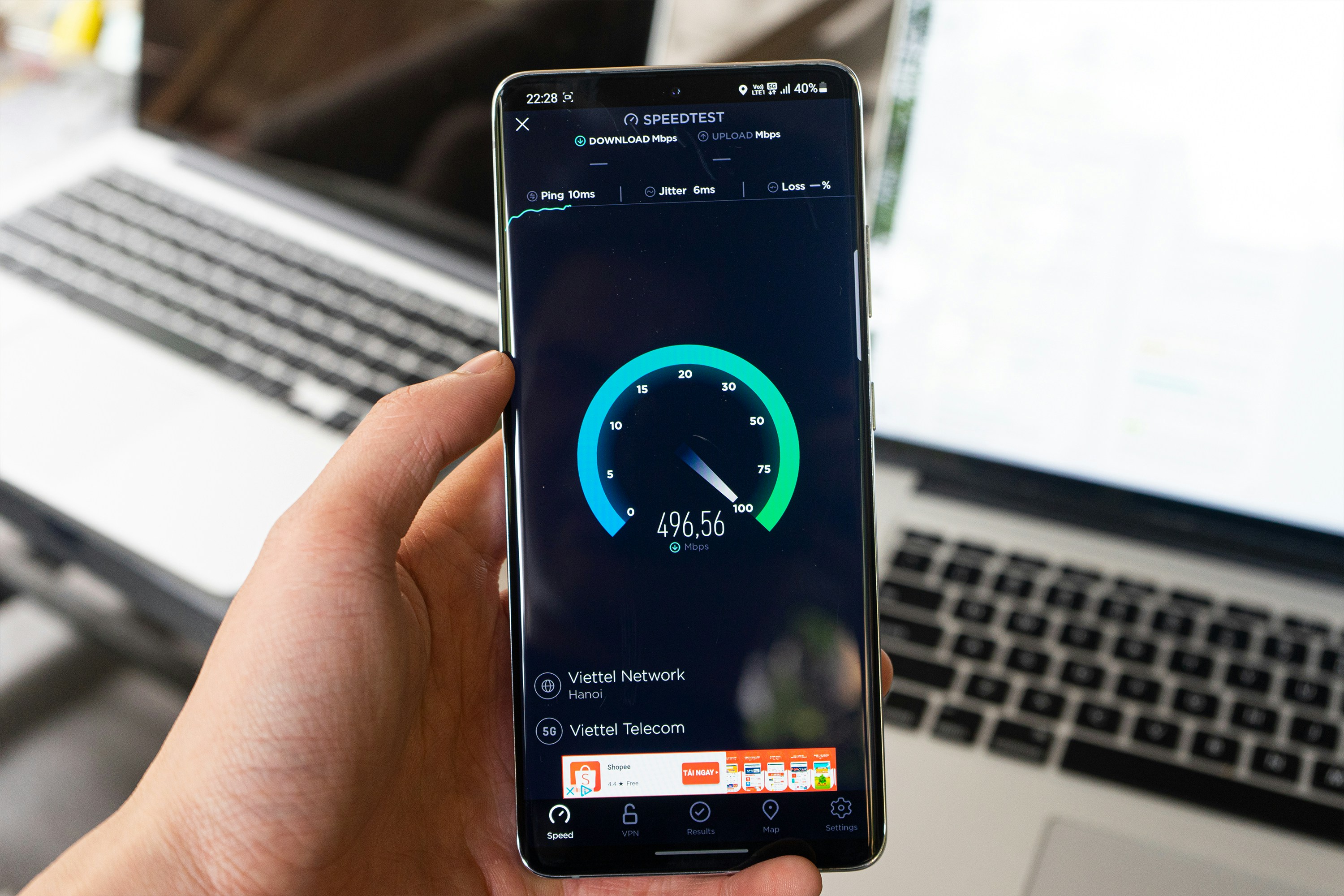
This is why running a basic internet speed test does not provide a complete picture of whether an internet connection is suitable for VoIP.
Network Congestion Can Affect Calls
Even an otherwise excellent internet connection can experience problems when too much traffic competes for the available capacity.
Imagine a business with a 20 Mbps upload connection.
Ten VoIP calls might consume only about 1 Mbps of that upload capacity.
Under normal conditions, there is plenty of room.
Now imagine that a computer begins uploading a 100 GB backup to the cloud and tries to use all 20 Mbps of upload bandwidth.
The VoIP traffic may suddenly be forced to compete with that backup.
Calls may experience delay, jitter, or dropped packets even though the telephone system itself has not changed.
What Is QoS?
Quality of Service, commonly abbreviated as QoS, is a set of network techniques used to prioritize certain types of traffic.
In a properly designed network, VoIP traffic can often be given priority over less time-sensitive activities.
If the network becomes congested, it is usually better to slow down a file transfer slightly than to interrupt a live telephone conversation.
QoS can help the network make that distinction.
However, QoS is not magic.
It cannot repair a failing internet circuit, eliminate packet loss occurring inside an ISP's network, or compensate indefinitely for inadequate bandwidth.
It is one tool used as part of a properly designed network.
Your Local Network Matters Too
When a business experiences poor VoIP quality, the internet provider is not always responsible.
The problem may exist inside the business itself.
VoIP traffic usually travels through several pieces of equipment before it ever reaches the internet.
A typical path might look like:
VoIP Phone → Network Switch → Firewall or Router → Internet Connection → VoIP Provider
A problem anywhere along that path can affect the call.
Common local-network issues include:
- Overloaded or failing network switches
- Damaged Ethernet cabling
- Improper firewall configuration
- Network loops
- Heavy traffic from other applications
- Misconfigured routers
- Poor Wi-Fi coverage
- Failing networking equipment
Wired Ethernet Is Usually Best for Desk Phones
Wi-Fi has improved tremendously and is an important part of modern business networks.
For a fixed VoIP desk phone, however, a wired Ethernet connection is generally preferable when one is available.
Ethernet typically provides a more consistent connection with fewer variables affecting packet delivery.
Wi-Fi performance can change based on:
- Distance from the wireless access point
- Walls and building materials
- Radio interference
- The number of connected devices
- Nearby wireless networks
- Roaming between access points
A laptop loading a webpage may barely notice a brief Wi-Fi interruption.
A live telephone conversation may make that same interruption immediately obvious.
How Many VoIP Calls Can My Internet Connection Handle?
From a pure bandwidth standpoint, usually far more than most businesses expect.
Using 100 Kbps per simultaneous call as a simple planning figure:
| Simultaneous Calls | Approximate Bandwidth Needed Each Direction |
|---|---|
| 5 calls | 0.5 Mbps |
| 10 calls | 1 Mbps |
| 25 calls | 2.5 Mbps |
| 50 calls | 5 Mbps |
| 100 calls | 10 Mbps |
These figures are estimates rather than absolute requirements, but they demonstrate just how little raw bandwidth voice traffic typically consumes.
A business capable of sustaining 100 simultaneous external telephone calls would be a substantial telephone environment, yet the actual voice traffic could still represent only a fraction of a modern fiber connection.
Why You Should Not Size Your Internet Connection for VoIP Alone
Although VoIP itself requires relatively little bandwidth, your phones are not the only devices using the internet.
A modern business may simultaneously be using:
- Microsoft 365 or Google Workspace
- Cloud backups
- Video conferencing
- Cloud-based accounting or ERP software
- Security cameras
- Remote desktop services
- File synchronization
- Software updates
- Streaming media
- Guest Wi-Fi
Internet capacity should therefore be planned around the business's overall technology environment, with enough additional capacity that normal traffic spikes do not interfere with real-time applications such as voice.
Do You Need Fiber Internet for VoIP?
No.
VoIP can operate successfully across many different types of internet connections.
Fiber is attractive because it often provides high capacity, low latency, strong reliability, and symmetrical upload and download speeds.
But businesses can also successfully operate VoIP across cable, fixed wireless, DSL, and other broadband technologies when those connections provide adequate quality and stability.
The best connection is not automatically the one with the largest speed number.
Reliability, packet delivery, latency, service quality, and support all matter.
What About Backup Internet Connections?
Businesses that rely heavily on telephone communications should also consider what happens when their primary internet service completely fails.
Even the best internet provider can experience an outage.
Depending on the business, a secondary connection may be worthwhile.
Backup connectivity could come from:
- A second wired internet provider
- A cellular connection
- Fixed wireless service
- Another available broadband technology
In many cases, the backup connection does not need to be nearly as fast as the primary connection.
Because VoIP itself uses relatively little bandwidth, even a modest backup circuit may be capable of maintaining essential telephone service during an outage.
Testing Your Internet for VoIP
A conventional speed test is useful, but it should not be the only measurement used when evaluating a connection for VoIP.
A more complete evaluation should consider:
- Download bandwidth
- Upload bandwidth
- Latency
- Jitter
- Packet loss
- Performance under load
- Connection stability over time
The final point is especially important.
A five-second test at 10:00 in the morning may look perfect while the connection experiences congestion every afternoon.
Intermittent problems often require monitoring over time rather than a single test.
Why VoIP Problems Can Be Difficult to Diagnose
Telephone service used to be relatively isolated from the rest of a company's technology.
With VoIP, the telephone system is part of the network.
That means a call-quality problem may involve:
- The physical phone
- The Ethernet connection
- A network switch
- The firewall
- The local internet circuit
- The ISP's network
- The route between networks
- The VoIP platform
- The telephone carrier
Finding the actual problem requires understanding where the audio is failing rather than simply replacing phones or purchasing a faster internet package.
A Faster Internet Plan Is Not Always the Solution
If a business has genuinely exhausted its available bandwidth, increasing internet capacity can absolutely help.
But if a business is using only 50 Mbps of a 500 Mbps connection and still experiencing poor calls, upgrading to 1 Gbps may accomplish nothing.
The more useful investigation would be to determine whether the network is experiencing:
- Packet loss
- Intermittent latency
- Jitter
- Firewall interference
- Local network congestion
- ISP instability
Speed is only one part of network performance.
What Should a Business Prioritize for Reliable VoIP?
For most organizations, reliable VoIP does not require extraordinary internet service.
It requires a properly designed environment.
Ideally, a business should have:
- A stable internet connection with sufficient upload and download capacity
- Low packet loss so voice information consistently reaches its destination
- Reasonable latency so conversations feel natural
- Low jitter so audio arrives consistently
- Quality networking equipment capable of reliably handling business traffic
- Proper firewall configuration that does not interfere with VoIP communications
- Enough spare capacity that normal business activity does not saturate the connection
- A continuity plan for internet outages when telephone availability is business-critical
How Much Bandwidth Does VoIP Need?
As a simple planning estimate, allow approximately 100 Kbps in each direction for every simultaneous business VoIP call when using a common high-quality voice configuration.
That means most modern business internet connections have more than enough raw bandwidth for VoIP.
The more important question is whether that connection can deliver those relatively small amounts of voice data consistently, quickly, and without losing packets along the way.
Final Thoughts
Businesses often focus on internet speed because it is the easiest network measurement to understand.
Internet providers advertise speed. Speed tests display large numbers. Faster plans appear to be automatically better.
For VoIP, however, speed tells only part of the story.
A clear and reliable telephone call does not require tremendous bandwidth. It requires a modest amount of bandwidth delivered consistently.
Packet loss, latency, jitter, congestion, firewall behavior, and network stability can all have a greater effect on call quality than whether your internet connection is rated for 200 Mbps or 2,000 Mbps.
That is why successful business VoIP should be treated as both a telephone service and a networking technology.
Having VoIP Call Quality Problems?
If your business has plenty of internet bandwidth but still experiences choppy audio, dropped calls, intermittent phone registrations, or other VoIP problems, simply purchasing a faster internet package may not address the underlying issue.
Vox Rail works with businesses and their IT providers to help identify where telephone and network issues intersect, allowing the actual cause of a VoIP problem to be addressed rather than relying on guesswork.