
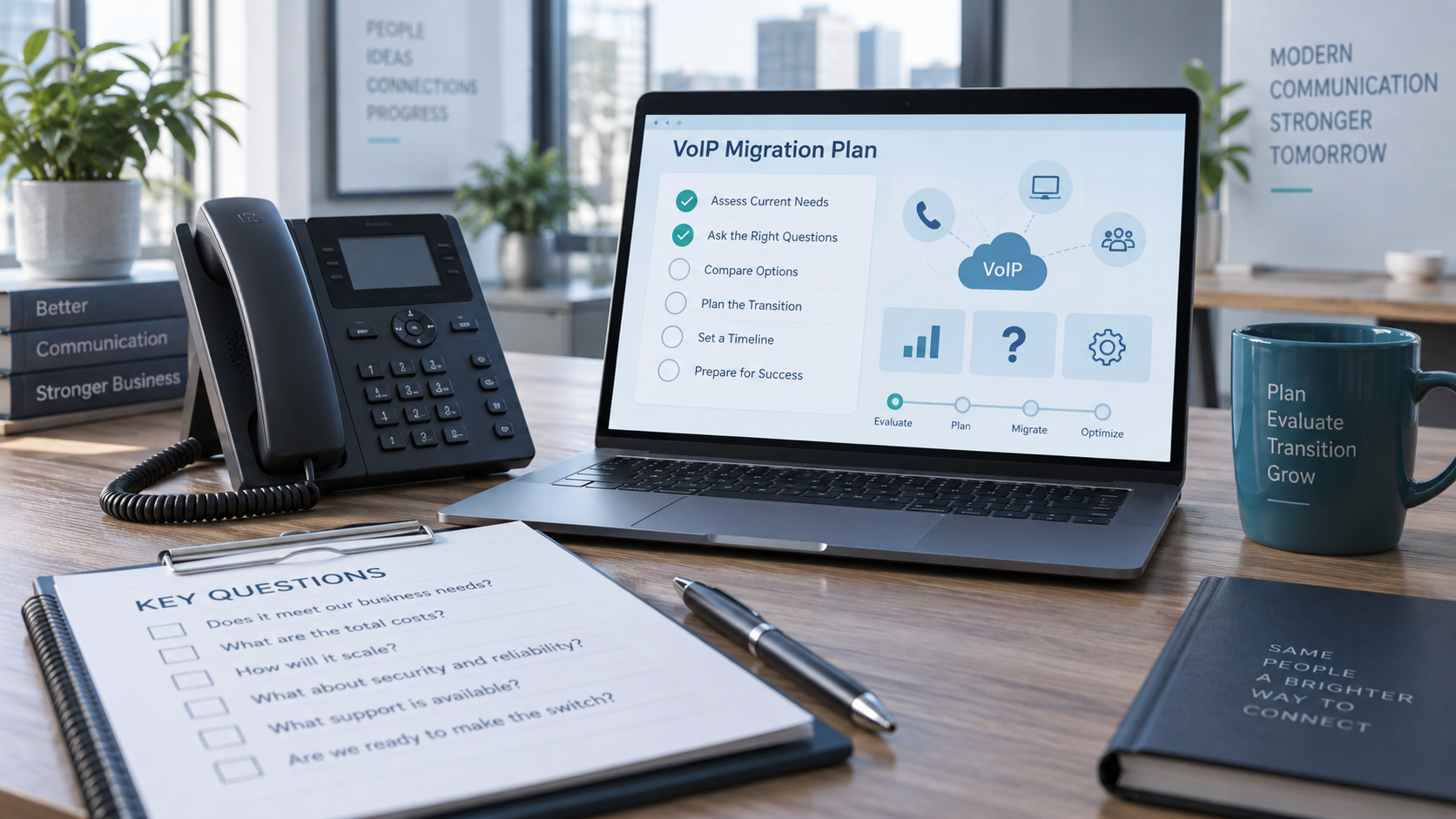
10 Questions to Ask Before Switching Your Business Phones to VoIP
Moving a business phone system to VoIP can improve flexibility, scalability, call routing, mobility, and cost control. But the quality of the result depends heavily on the provider, network, system design, and migration plan. Before making the switch, these are the questions every business should ask.
VoIP has become the standard direction for modern business communications.
It allows businesses to move beyond traditional phone lines and use flexible, software-driven phone systems that can support multiple locations, remote employees, call queues, mobile applications, advanced routing, voicemail-to-email, reporting, and much more.
But moving to VoIP is not simply a matter of plugging in new phones.
A successful transition depends on several pieces working together:
- The local network
- The internet connection
- The VoIP platform
- The telephone carrier
- The phones and applications
- Emergency calling
- Call routing
- Ongoing support
Asking the right questions before signing an agreement can help prevent surprises later.
The goal should not be to find the cheapest VoIP service. It should be to find a system that fits how your business actually communicates.
The Quick Checklist
- Is our internet connection reliable enough for VoIP?
- What happens if our internet goes down?
- How will 911 and emergency calling work?
- What does the total cost actually include?
- What kind of phones and devices can we use?
- How flexible is the call routing?
- How is the system secured?
- What support do we receive when something goes wrong?
- How will the number-porting and migration process work?
- Can the system grow and change with the business?
1. Is Our Internet Connection Reliable Enough for VoIP?
This should be one of the first questions.
VoIP does not usually require a tremendous amount of bandwidth.
A typical business VoIP call may use only a small fraction of a megabit per second.
The more important issue is the quality and consistency of the connection.
A business can have a very fast internet connection and still experience poor VoIP calls if the network has:
- Packet loss
- High latency
- Jitter
- Heavy congestion
- Unstable Wi-Fi
- Poor firewall configuration
A provider should evaluate more than the number printed on an internet speed test.
The better question is:
Can our network consistently deliver real-time voice traffic without delay or packet loss?
That is much more important than whether your internet plan says 500 Mbps or 1 Gbps.
2. What Happens If Our Internet Goes Down?
Every internet provider has outages eventually.
A good VoIP provider should be able to explain exactly what happens when your office loses connectivity.
If the system is hosted remotely, the PBX itself may continue operating even though the office phones temporarily lose access.
That gives the system options.
Incoming calls may be able to fail over to:
- Mobile phones
- Another office
- Remote employees
- An answering service
- Voicemail
Businesses that cannot tolerate phone downtime should also consider a secondary internet connection.
A backup circuit may be much less expensive than the cost of being unreachable for several hours.
3. How Will 911 and Emergency Calling Work?
Emergency calling should never be an afterthought.
Traditional telephone lines were naturally associated with a physical address.
VoIP phones can be moved between offices, homes, or other locations, which makes emergency-location information more complicated.
Businesses should ask:
- What address is associated with each phone or user?
- Can emergency-location information be updated?
- How are remote employees handled?
- What happens if a device moves to another location?
- What happens if the internet connection is unavailable?
A provider should have a clear, documented process for emergency calling.
"It should work" is not a sufficient answer.
4. What Does the Total Cost Actually Include?
VoIP pricing can appear simple until optional fees begin accumulating.
One provider may advertise a low monthly per-user price while charging separately for:
- Desk phones
- Number porting
- Call recording
- Mobile applications
- Auto attendants
- Call queues
- Voicemail transcription
- Emergency-service fees
- Taxes and regulatory fees
- Support
Another provider may bundle many of those features into the standard service.
Ask for a complete estimate based on your actual environment.
The important question is not:
"What is your price per phone?"
It is:
"What will our actual monthly cost be for the system we need?"
5. What Kind of Phones and Devices Can We Use?
Not every business wants to work the same way.
Some employees prefer traditional desk phones.
Others may need:
- Cordless phones
- Mobile applications
- Desktop softphones
- Conference phones
- Headsets
- Paging devices
Ask whether the provider supports only certain manufacturers or requires proprietary hardware.
Also ask whether you own the phones or lease them.
Hardware ownership can matter later if you change providers.
Some phones can be reused elsewhere.
Others may be locked to a specific provider or platform.
Understanding that before purchasing dozens of devices can save a significant amount of frustration.
6. How Flexible Is the Call Routing?
One of the greatest advantages of a modern VoIP system is the ability to control how calls move through the organization.
Before choosing a platform, think about how your business actually handles calls today.
Do you need:
- An auto attendant
- Ring groups
- Call queues
- After-hours routing
- Holiday schedules
- Overflow routing
- Call forwarding to mobile users
- Different routing for different business numbers
Ask whether those features are included or require additional fees.
More importantly, ask how flexible the system is when your workflow changes.
A phone system should adapt to the business, not force the business to adapt to the phone system.
7. How Is the System Secured?
A VoIP system is part of the business's IT environment.
That means it needs to be treated like any other network-connected system.
Poorly secured phone systems can be targeted for:
- Password attacks
- Toll fraud
- Unauthorized calling
- Account compromise
- Service disruption
Ask your provider about:
- Firewall protections
- Encrypted communications
- Administrative access controls
- Multi-factor authentication
- Monitoring
- Software and firmware updates
- Protection against repeated login attempts
Security should be part of the system design from the beginning.
It should not be an optional add-on after deployment.
8. What Support Do We Receive When Something Goes Wrong?
Every technology system eventually needs support.
The important question is what that support actually looks like.
Ask:
- Who do we call?
- Are we talking directly to the provider or to a general call center?
- What are the support hours?
- Is emergency support available?
- What is included with our service?
- Are certain support requests billable?
It is also worth asking how the provider handles problems that cross the boundary between telephony and IT.
Many VoIP problems involve the local network, firewall, or ISP connection.
A provider that understands networking can often work more effectively with your IT team to identify the actual cause.
If the provider's standard answer is:
"Our system is working, so call your IT company."
that may be technically convenient for the provider, but not particularly helpful to the customer.
9. How Will the Number-Porting and Migration Process Work?
Switching phone systems is not only about installing phones.
Your existing business telephone numbers usually need to be transferred, or ported, from the current carrier to the new provider.
That process needs to be handled carefully.
Ask:
- Who manages the port request?
- How long does the process normally take?
- Will the old service remain active until the port completes?
- How will the cutover be scheduled?
- What happens if the port is delayed?
- How will temporary routing be handled?
The safest migrations are usually staged.
New phones and call flows can often be configured and tested before the telephone numbers are moved.
That way, the business is not trying to design the system on the same day customers begin calling it.
10. Can the System Grow and Change With the Business?
The phone system you need today may not be the system you need three years from now.
Businesses hire employees, open offices, close offices, reorganize departments, adopt new applications, and change how customers contact them.
Ask whether the proposed VoIP platform can adapt.
Consider:
- How easy is it to add extensions?
- Can new locations join the same system?
- Can remote employees be added?
- Can call flows be changed later?
- Can new phone numbers be added easily?
- Are integrations available?
- Will the platform still fit if the company doubles in size?
Scalability does not simply mean supporting more phones.
It means being able to change the system without rebuilding it from scratch.
Bonus Question: Who Actually Owns Our Phone Numbers?
This is worth asking even though it is not always discussed during the sales process.
Your business phone numbers are valuable.
Customers may have used the same number for years.
The number may appear on:
- Websites
- Business cards
- Invoices
- Advertising
- Customer contact lists
Make sure your provider allows you to port those numbers away later if you choose to change services.
A business should not discover during cancellation that moving its own telephone numbers is unexpectedly difficult.
Bonus Question: Are We Buying Features We Will Never Use?
VoIP providers often promote long feature lists.
Some of those capabilities are genuinely useful.
Others may never matter to your business.
A 10-person professional office may not need the same contact-center features as a 200-seat support department.
Likewise, a warehouse may care more about paging, cordless phones, and durable handsets than sophisticated desktop applications.
The best phone system is not the one with the largest number of features.
It is the one whose features match the way your employees and customers actually communicate.
Do Not Forget the Local Network
A new VoIP platform cannot compensate for an unhealthy network.
Before migration, it is worth reviewing:
- Network switches
- Power over Ethernet capacity
- Firewall configuration
- Internet reliability
- Ethernet cabling
- Wi-Fi coverage
- Backup power
Many bad VoIP experiences are blamed on the phone system when the underlying problem is actually elsewhere on the network.
A good deployment accounts for both sides.
A Good Provider Should Ask You Questions Too
Choosing a VoIP provider should not feel like ordering a generic internet package.
The provider should be asking about your business.
They should want to know:
- How many employees you have
- How customers reach you
- What happens after hours
- Whether you have multiple locations
- Whether employees work remotely
- Which departments receive the most calls
- Whether you need call recording or reporting
- How much downtime you can tolerate
If the provider recommends the exact same configuration to every business, that should raise questions.
Business communications are rarely one-size-fits-all.
Do Not Choose a Provider Based Only on Price
Price matters.
It should absolutely be part of the decision.
But business phone service is one of those areas where the lowest monthly price can become expensive if:
- Calls are unreliable
- Support is difficult to reach
- Important features cost extra
- The system cannot adapt to your workflow
- Employees lose productivity
- Customers cannot reach the business
A phone system is part of the customer experience.
Reliability and support often matter more over the life of the system than saving a few dollars per user each month.
Red Flags to Watch for During the Sales Process
Businesses should be cautious when a provider:
- Cannot clearly explain how outages are handled
- Avoids discussing 911 configuration
- Will not provide a complete fee schedule
- Requires proprietary hardware without explaining why
- Cannot explain how phone numbers can be ported away later
- Dismisses network quality as irrelevant
- Pushes a standard package before understanding your workflow
- Cannot clearly describe the support process
A reputable provider should be comfortable discussing limitations as well as benefits.
What Should You Have Ready Before Requesting a VoIP Quote?
You can make the planning process much easier by gathering a few details before speaking with providers.
Useful information includes:
- Number of employees
- Number of locations
- Existing telephone numbers
- Current phone models
- Departments that receive inbound calls
- Current internet providers and speeds
- Remote-user requirements
- Desired call-routing behavior
- Current monthly phone-service costs
The more accurately a provider understands your environment, the more useful the proposal can be.
The 10 Questions Worth Asking
- Is our internet and network ready for VoIP?
- What happens if our internet connection fails?
- How is 911 and emergency calling handled?
- What will the system actually cost us each month?
- What hardware and applications can we use?
- Can the call routing match how our business works?
- How is the phone system secured?
- What support is available when we need help?
- How will our existing numbers and service be migrated?
- Can the system grow with us?
Final Thoughts
Switching to VoIP can be one of the most useful communications upgrades a business makes.
A well-designed system can provide better mobility, more intelligent call routing, easier expansion, improved reporting, and a more professional customer experience.
But those benefits are not automatic.
They depend on choosing the right provider, planning the migration carefully, and making sure the system is designed around the realities of the business.
Ask questions about reliability.
Ask questions about security.
Ask what happens during an outage.
Ask what support looks like after the sale.
And make sure you understand the full cost before signing anything.
A good VoIP provider should welcome those questions.
More importantly, they should be able to answer them clearly.
Considering a Move to VoIP?
The right business phone system should be built around how your organization actually communicates, not around a generic package or feature list.
Vox Rail helps businesses evaluate their existing phones, network, internet connectivity, call flow, redundancy needs, and growth plans before designing a VoIP system that fits the environment rather than forcing the environment to fit the system.