
What Is VoIP and Why Is It Important for Modern Businesses?
Voice over Internet Protocol, better known as VoIP, has changed the way businesses communicate. What once required dedicated telephone lines, specialized infrastructure, and expensive long-distance service can now be handled over the same networks businesses already use for internet access.
For many businesses, the telephone is still one of the most important ways customers, employees, vendors, and partners communicate. Even as email, messaging, video meetings, and online collaboration have become common, a dependable business phone system remains essential.
The technology behind those phone systems, however, has changed dramatically.
Instead of relying on traditional copper telephone lines, modern business phone systems increasingly use VoIP, or Voice over Internet Protocol. VoIP allows voice conversations to travel across IP networks, including private business networks and the internet.
That may sound highly technical, but the basic idea is simple: VoIP turns a phone call into digital network traffic.
This change has made business telephone systems more flexible, scalable, feature-rich, and easier to integrate with the rest of a company's technology.
What Does VoIP Actually Mean?
The term Voice over Internet Protocol describes technology that carries voice communications using Internet Protocol, or IP.
IP is the same basic communication method used by computers, servers, websites, cloud services, printers, smartphones, security cameras, and countless other connected devices.
With a traditional telephone system, your voice traveled across a telephone network specifically designed for voice calls. With VoIP, your voice is converted into digital information and sent across a data network.
In practical terms, when you speak into a VoIP phone:
- The phone captures your voice.
- Your voice is converted into digital audio.
- That audio is divided into small packets of data.
- Those packets travel across the network to the phone system or service provider.
- The packets are reassembled into audio for the person on the other end of the call.
This happens so quickly that, under normal conditions, the conversation feels just like any other telephone call.
VoIP Does Not Necessarily Mean "Calling Through a Computer"
One common misunderstanding is that VoIP means employees must sit at a computer and use a headset to make phone calls.
That is one option, but it is only one of many.
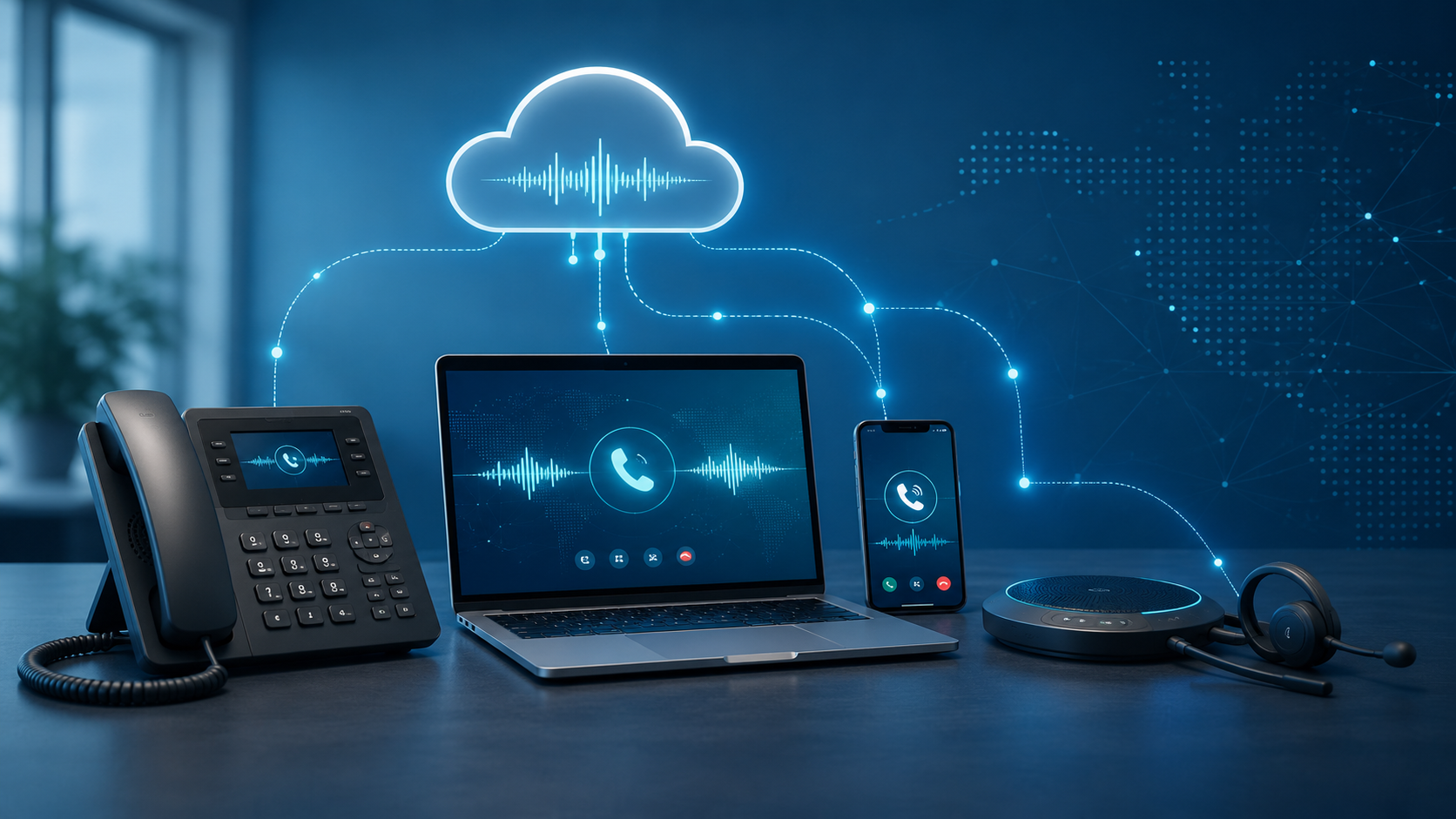
A modern VoIP system can support:
- Traditional-looking desk phones
- Cordless business phones
- Desktop applications
- Laptop softphones
- Mobile phone applications
- Conference room phones
- Headsets
- Intercoms and paging devices
To an employee, using VoIP may feel almost identical to using a traditional office phone. The major difference is what happens behind the scenes.
How Business Phone Systems Used to Work
For decades, business telephone systems relied heavily on dedicated telephone infrastructure.
A company might have had multiple physical phone lines entering the building, along with an on-site PBX, or Private Branch Exchange, that connected employee extensions to one another and to the outside telephone network.
These systems often worked well, but they could also be expensive and inflexible.
Adding employees might require additional cabling, hardware, telephone lines, or expansion cards. Moving an employee from one office to another could involve physically rewiring their telephone extension. Supporting multiple office locations could require separate phone systems and complicated interoffice connections.
Long-distance calling also represented a much larger expense than it does today.
VoIP changed that model by allowing voice communications to share modern data networks.
Why VoIP Became So Important
VoIP is important because modern businesses are no longer confined to a single building, a single network, or even a single geographic area.
Employees may work from an office one day and from home the next. Companies may operate several branches across different cities or states. Employees may travel regularly while still needing access to their business telephone number.
Traditional telephone systems were designed around physical locations.
VoIP systems are designed around users, devices, networks, and connectivity.
That difference is one of the reasons VoIP has become such a fundamental part of modern business communications.
One Business Number Can Follow You Almost Anywhere
With a traditional office telephone system, a phone number was often closely tied to a specific physical line or location.
VoIP makes telephone service much more portable.
An employee might have the same business extension available on an office desk phone, a laptop application, and a mobile application.
A customer can continue calling the same business number regardless of where the employee happens to be working.
This can be especially valuable for sales teams, service companies, distributed organizations, remote employees, and businesses with several locations.
VoIP Makes Multiple Locations Easier to Connect
Imagine a company with offices in Boise, Spokane, Salt Lake City, and Denver.
With older telephone systems, each office might operate its own independent phone system.
With a properly designed VoIP environment, all of those locations can function as part of a unified telephone system.
An employee in one office can dial another employee's extension just as if they were down the hallway.
Calls can be routed between locations, departments, remote employees, or centralized answering teams without customers needing to understand how the organization is physically structured.
To the caller, the entire company can feel like one connected organization.
Modern VoIP Systems Can Do Much More Than Make Phone Calls
One of the biggest advantages of VoIP is that the telephone system becomes software-driven.
That makes it possible to add features that once required expensive specialized equipment.
Common business VoIP features can include:
- Auto attendants that direct callers to the correct department
- Ring groups that ring several employees at once
- Call queues for customer service and support departments
- Voicemail-to-email delivery
- Call recording
- Business-hours routing
- Holiday schedules
- Call forwarding
- Extension dialing between locations
- Conference calling
- Mobile and desktop applications
- Detailed call reporting
- Caller ID management
- Custom routing based on time, department, or caller needs
The telephone system becomes less like a collection of physical phone lines and more like a communications platform that can be customized around the needs of the business.
VoIP Can Make a Business Easier to Scale
Businesses change.
Employees are hired. Departments grow. New offices open. Teams move. Seasonal workers come and go.
A traditional phone system could make these changes cumbersome because telephone capacity was often directly tied to physical infrastructure.
VoIP systems can usually adapt much more easily.
Adding an employee may simply involve creating a new extension and assigning a phone or application to that user. In many cases, the existing network can carry the additional telephone traffic without requiring an entirely new set of telephone lines.
For a growing business, this flexibility can be extremely valuable.
VoIP and Remote Work
Remote and hybrid work significantly accelerated the importance of internet-based communications.
Businesses discovered that employees needed access to the same communication tools regardless of where they were physically located.
VoIP is particularly well suited for this environment.
A remote employee can potentially use a desk phone at home, a desktop application, or a mobile application while still appearing to customers as part of the company's normal telephone system.
Calls can still come from the company's primary telephone number. Internal extension dialing can still work. Voicemail, call transfers, queues, and other business features can remain available.
This means employees do not necessarily need to expose personal cell phone numbers or operate outside the company's normal communications workflow.
Does VoIP Require the Internet?
In many modern implementations, yes.
If your business uses a hosted or remotely managed VoIP system, your phones generally communicate with that system across an internet connection or a secured network connection.
Because of that, the quality of your network and internet service becomes an important part of the quality of your telephone service.
This is one of the most important differences between traditional telephone lines and VoIP.
A reliable VoIP deployment should consider much more than just the phones themselves.
Important factors include:
- Internet reliability
- Network stability
- Firewall configuration
- Network congestion
- Latency
- Packet loss
- Jitter
- Power availability
- Network equipment quality
VoIP itself is extremely capable, but it depends on the network carrying the conversation.
Why Network Quality Matters for VoIP
Most business internet activities are surprisingly tolerant of small network problems.
If a webpage takes an extra second to load, users may barely notice. If an email takes a few additional seconds to send, it usually does not matter.
Voice traffic is different because it happens in real time.
During a phone conversation, audio packets need to arrive quickly, consistently, and in the correct order.
If too many packets are delayed or lost, callers may experience:
- Choppy audio
- Robotic-sounding voices
- Delayed conversation
- One-way audio
- Dropped calls
This is why a business VoIP provider should understand networking in addition to telephone systems.
The phone system and the network carrying the phone calls are closely connected.
Is VoIP Reliable?
Properly designed VoIP systems can be extremely reliable.
Businesses around the world depend on VoIP every day for customer service, sales, emergency communications, internal collaboration, healthcare, education, government operations, and countless other applications.
Reliability depends heavily on how the system is designed and supported.
A strong deployment may include redundancy, monitoring, backup routing, quality network equipment, properly configured firewalls, secure remote connectivity, uninterruptible power supplies, and alternative call-routing plans when a location loses internet connectivity.
In other words, reliability is not simply a characteristic of the phone itself. It is the result of the entire communications environment working together.
What Happens If the Internet Goes Down?
This is one of the most important questions a business should ask before moving to VoIP.
If the internet connection at an office fails, the phones at that location may no longer be able to communicate with a remote VoIP system.
However, a well-designed phone system can provide options that traditional phone systems often could not.
Incoming calls might automatically be redirected to:
- Another office location
- Employee mobile phones
- A remote answering service
- A voicemail system
- A backup internet-connected device
Some businesses also deploy secondary internet connections, cellular failover, or other redundancy to help keep their communications online during outages.
The important point is that business continuity should be part of the system design rather than an afterthought.
VoIP Can Help Reduce Telecommunications Costs
Cost savings were one of the earliest reasons businesses adopted VoIP, although today flexibility and functionality are often just as important.
Traditional telephone systems could require separate monthly charges for individual lines, long-distance plans, maintenance agreements, specialized wiring, expansion hardware, and proprietary equipment.
VoIP can simplify many of those costs by using shared network infrastructure and software-based services.
The exact savings vary from one business to another, but VoIP often provides more functionality per user than older telephone technologies.
VoIP Is About More Than Cost Savings
Choosing VoIP solely because it may reduce a telephone bill misses much of its value.
The larger advantage is that communications become much more adaptable.
Businesses can build call flows around how they actually operate.
For example, a customer calling a company might hear a simple menu that allows them to select sales, support, billing, or another department.
A support call can be distributed among several employees. If nobody answers within a certain amount of time, the call can automatically move to another team or location. After hours, calls can follow an entirely different route.
These workflows can improve the customer experience while also making employees more efficient.
VoIP and the Customer Experience
A company's phone system often plays a larger role in the customer experience than people realize.
When someone calls a business, they usually expect to reach the correct person or department quickly.
They do not want to repeat their story several times, call multiple numbers, or wonder whether their voicemail disappeared.
A properly configured VoIP system can help create a more consistent experience by intelligently routing calls and giving employees better tools for handling them.
This can be particularly important for organizations that receive a large number of inbound calls or depend heavily on telephone-based customer relationships.
VoIP Can Provide Better Visibility Into Business Calls
Traditional phone systems often provided very little information about what was happening with calls.
Modern VoIP systems can provide detailed reporting.
Depending on the system, a business may be able to review:
- Inbound call volume
- Outbound call volume
- Missed calls
- Average call duration
- Queue wait times
- Call recordings
- Department activity
- Busy periods
- Call routing history
This information can help management identify staffing issues, missed opportunities, customer-service bottlenecks, and trends that were difficult to see with older telephone systems.
Is VoIP Secure?
VoIP can be secure, but like any network-connected technology, it must be configured and maintained properly.
Because VoIP systems communicate over data networks, they can be targeted by the same kinds of threats that affect servers, applications, and other internet-connected systems.
Poorly secured telephone systems may be vulnerable to unauthorized access, toll fraud, password attacks, account compromise, or service disruption.
A professionally managed VoIP environment should use appropriate security practices such as:
- Strong credentials
- Restricted network access
- Firewall protections
- Encrypted connections where appropriate
- Software and firmware updates
- System monitoring
- Protection against repeated login attempts
- Secure remote-access methods
Security should be considered part of the telephone system itself, not a separate concern.
What About 911 and Emergency Calling?
Emergency calling deserves special attention with VoIP systems.
Traditional landlines were naturally associated with a physical location because the telephone line entered a specific building.
VoIP extensions can be much more portable. A phone may be moved to another office, used remotely, or registered from another location.
Because of that flexibility, businesses need to make sure emergency-service information is properly configured and maintained.
The address associated with an emergency call should accurately represent where the caller is located whenever possible.
This is especially important for companies with several locations, remote employees, or devices that may move between sites.
VoIP Is Not the Same as "Cloud Phone Service"
The terms VoIP and cloud phone system are often used interchangeably, but they are not exactly the same thing.
VoIP describes the underlying method used to carry voice traffic over IP networks.
A cloud phone system generally describes where the phone system itself is hosted.
For example, a business could operate:
- An on-premises VoIP phone system
- A hosted VoIP phone system
- A cloud-based PBX
- A hybrid environment combining several technologies
They can all use VoIP while being designed very differently.
What Is SIP and How Does It Relate to VoIP?
Businesses researching VoIP will often encounter another acronym: SIP.
SIP stands for Session Initiation Protocol.
In simple terms, SIP is one of the primary technologies used to establish, manage, and end VoIP calls.
VoIP is the broader concept of transmitting voice over IP networks. SIP is one of the technologies commonly used to make those communications happen.
You do not need to understand the technical details of SIP to use a VoIP phone system, but the term appears frequently when discussing modern telephone services.
What Is a SIP Trunk?
A SIP trunk is essentially a digital connection between a business phone system and a telephone service provider.
In older systems, a business might have purchased several physical telephone lines from the phone company.
With SIP trunking, those connections can instead be delivered over an IP network.
SIP trunks can carry multiple simultaneous telephone calls without requiring one physical copper line for every conversation.
This is another example of how VoIP moves business telephone service away from physical infrastructure and toward flexible, software-driven networking.
Why VoIP Has Become the Standard Rather Than the Alternative
Years ago, businesses often viewed VoIP as an alternative to a traditional telephone system.
Today, that relationship has largely reversed.
IP-based communication is now the normal direction of the telecommunications industry.
Modern offices are built around data networks. Employees expect mobility. Businesses operate across multiple locations. Remote work has become common. Customers expect companies to answer calls efficiently regardless of where employees are located.
VoIP fits naturally into that environment.
Traditional telephone infrastructure increasingly does not.
Not Every VoIP System Is the Same
It is important to understand that choosing VoIP is not the same as choosing a specific phone system.
There are many providers, platforms, deployment models, telephone manufacturers, network designs, and support approaches.
A system that works well for a five-person professional office may not be the right design for a company operating hundreds of phones across multiple locations.
Similarly, a system designed primarily around mobile applications may not be ideal for a warehouse, medical office, manufacturing facility, school, or other environment that depends heavily on physical desk phones, paging, or specialized call routing.
The best VoIP system is not necessarily the one with the longest feature list.
It is the one designed around how the business actually communicates.
Questions a Business Should Ask Before Choosing VoIP
Businesses considering a new phone system should look beyond price alone.
Some important questions include:
- How reliable is our internet connection?
- What happens to incoming calls if our office loses internet access?
- Do we need desk phones, mobile apps, desktop apps, or a combination?
- How many simultaneous calls does the business typically handle?
- Do employees work remotely?
- Do we operate multiple locations?
- Do we need call recording or reporting?
- Do we need queues, auto attendants, paging, or specialized routing?
- How will emergency calling be handled?
- Who manages the network if call-quality problems occur?
- What security protections are in place?
- What type of support is available when something goes wrong?
These questions help determine whether a proposed system actually fits the business rather than simply replacing one telephone bill with another.
The Phone System Is Now Part of the IT Environment
Perhaps the most important change brought by VoIP is that business telephone service is no longer completely separate from information technology.
The phone system depends on network switches, routers, firewalls, internet connections, DNS, software, security policies, and remote connectivity.
That means telephone problems may sometimes originate outside the telephone system itself.
A phone can be working perfectly while a network problem causes poor audio. A telephone server can be healthy while an improperly configured firewall interferes with connections. An internet outage can affect an entire office even though the phone provider's infrastructure remains fully operational.
For this reason, successful VoIP deployments benefit greatly from coordination between the telephone provider and the organization or IT provider responsible for the network.
Why VoIP Matters for Small and Mid-Sized Businesses
Large enterprises have had sophisticated communications systems for many years.
One of the most significant effects of VoIP is that many of those capabilities are now practical for much smaller organizations.
A small business can have professional call routing, extension dialing, voicemail-to-email, remote employees, call queues, business-hour schedules, detailed reporting, and multi-location communications without maintaining the kind of specialized telephone infrastructure that would once have been required.
This allows smaller organizations to provide a professional caller experience while remaining flexible as the company grows.
The Future of Business Communications Is IP-Based
Telephone technology continues to evolve, but the transition toward IP-based communication is well established.
Voice, video, messaging, conferencing, customer-service platforms, and collaboration tools are increasingly interconnected.
Businesses expect communications to work across devices and locations rather than being tied to a physical telephone jack.
VoIP provides the foundation that makes much of that possible.
The traditional desk phone is not necessarily disappearing. In many businesses, it remains the most practical and dependable way to communicate.
What has changed is the network behind that phone.
So, What Is VoIP?
At its simplest, VoIP is a way of carrying telephone conversations across modern computer networks instead of relying exclusively on traditional telephone lines.
But its importance goes far beyond the technology itself.
VoIP gives businesses the ability to connect employees across locations, support remote work, build smarter call routing, gain better visibility into communications, scale more easily, and integrate telephone service into the rest of the modern IT environment.
Final Thoughts
The telephone remains one of the most direct connections between a business and its customers.
VoIP has modernized that connection.
Instead of thinking about a business phone system as a collection of lines and handsets, organizations can now think of it as a flexible communications platform that connects employees, customers, offices, and devices.
For most businesses, the question is no longer whether VoIP will play a role in their communications strategy.
It is how that VoIP environment should be designed, secured, supported, and integrated into the way the business actually works.
Looking at a New Business Phone System?
Whether you are replacing an older telephone system, opening a new office, supporting remote employees, or trying to improve how calls move through your organization, a properly designed VoIP system can provide significantly more flexibility than traditional telephone service.
Vox Rail helps businesses design and manage practical VoIP solutions around their actual communication and network requirements, rather than forcing every organization into the same one-size-fits-all configuration.